Key Answer: An AI Agent is software that, when given a goal by a human, allows an LLM (Large Language Model) to autonomously plan tasks, invoke tools such as search, APIs, or internal systems, and continuously verify results to complete the work. Unlike chatbots that only provide answers to questions, AI agents perform actual actions. Therefore, while they offer convenience, proper permission management and security controls must be designed concurrently.
- Definition: LLM-based autonomous execution software that iterates through goal setting, planning, tool execution, and result verification.
- Components: LLM (brain), Planning, Tools (connected via MCP, etc.), Memory
- Types: Autonomy Level (Assistive·Semi-Autonomous·Autonomous), Configuration (Single·Multi-Agent), Business Function (Coding·Business Automation·Customer Service·Security Operations)
- Key Risks upon Adoption: Prompt Injection, Excessive Permissions, External Tool Connectivity, Data Leakage
Last updated: November 2026
What is an AI Agent? Definition and Meaning
In a single sentence, an AI agent can be defined as 'AI that receives a goal, autonomously plans, and uses tools to complete tasks.' This represents a transition from 'talking AI' to 'working AI.' For instance, upon receiving a request such as, "Summarize last week's incident tickets and share them with the responsible team," the agent would query the ticket system, summarize the content, and invoke messenger or email tools to complete the sharing process. Humans specify the goal and provide approval, while the agent makes decisions for intermediate steps.
Differences Between AI Agents and Chatbots
The primary distinction is that chatbots generate answers, whereas AI agents perform actions.
| Category | Chatbot (Generative AI Conversation) | AI Agent |
|---|---|---|
| Function | Answers questions, summarizes, drafts content | Receives a goal, plans and executes multiple steps |
| External Systems | Mostly not connected | Invokes search, API, DB, internal systems as tools |
| Outcome | Text | Actual changes (e.g., ticket creation, email dispatch, configuration alteration) |
| Human Role | Reads answers and processes directly | Specifies goals, approves critical steps, reviews results |
| Primary Risks | Incorrect answers (hallucinations) | Incorrect actions: Permission misuse, data leakage, cascading errors |
Differences Between Agentic AI and AI Agents
Agentic AI refers to the method or characteristic by which AI autonomously subdivides goals, plans, executes, and modifies tasks. In contrast, an AI Agent refers to an individual software program that operates using this method. Thus, it can be understood that "an Agentic AI system consists of one or more AI agents." In practical applications, these terms are often used interchangeably.
AI Agent Operating Mechanism and Structure
Most AI agents are composed of four core components and repeatedly perform 'thinking, executing tools, observing results, and deciding on the next action' until the goal is achieved.
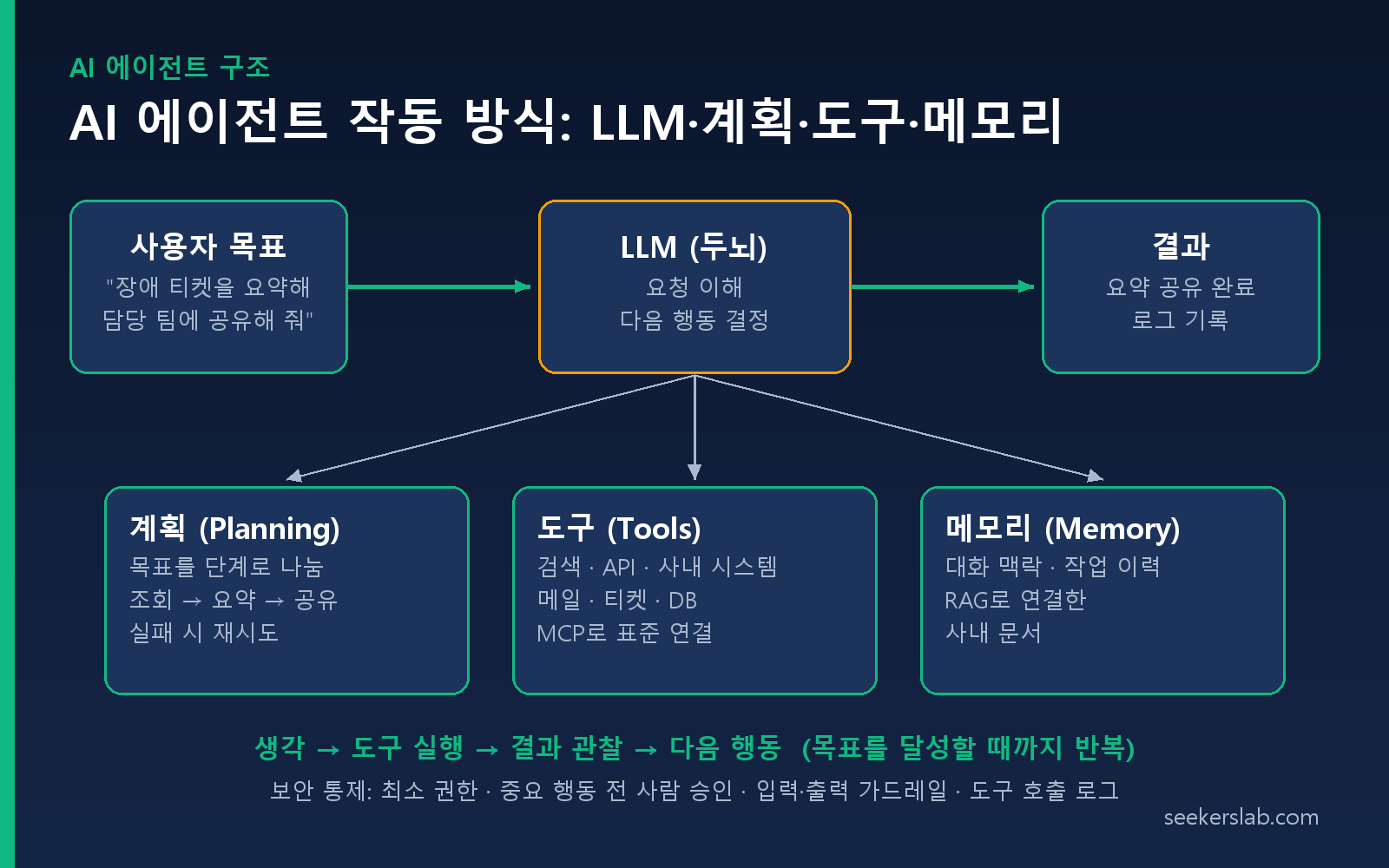 AI Agent Operating Mechanism: The LLM plans and uses tools (MCP) and memory, repeating the process until the goal is achieved.
| Component | Role | Example |
|---|---|---|
| LLM (Brain) | Understands requests and determines the next action | Commercial LLM APIs, internally deployed open-source LLMs |
| Planning | Breaks down goals into smaller steps and sequences them | Determines the sequence "Query → Summarize → Share," retries upon failure |
| Tools | Functions·APIs that perform actual tasks | Search, internal DB queries, ticket creation, email dispatch, code execution |
| Memory | Retains conversation context and previous results | Task history, user preferences, internal documents connected via RAG |
AI Agents and MCP·A2A
- MCP (Model Context Protocol): This is a standardized protocol for AI agents to access external tools and data. It has gained rapid adoption because it eliminates the need to write separate integration code for each tool. However, connected tool servers can become attack vectors. For detailed information, please refer to MCP Security Guide: How to Securely Connect AI Agents to Internal Systems.
- A2A (Agent2Agent): This is a communication standard for different AI agents to exchange tasks. It is utilized for inter-agent collaboration within multi-agent systems.
Types of AI Agents
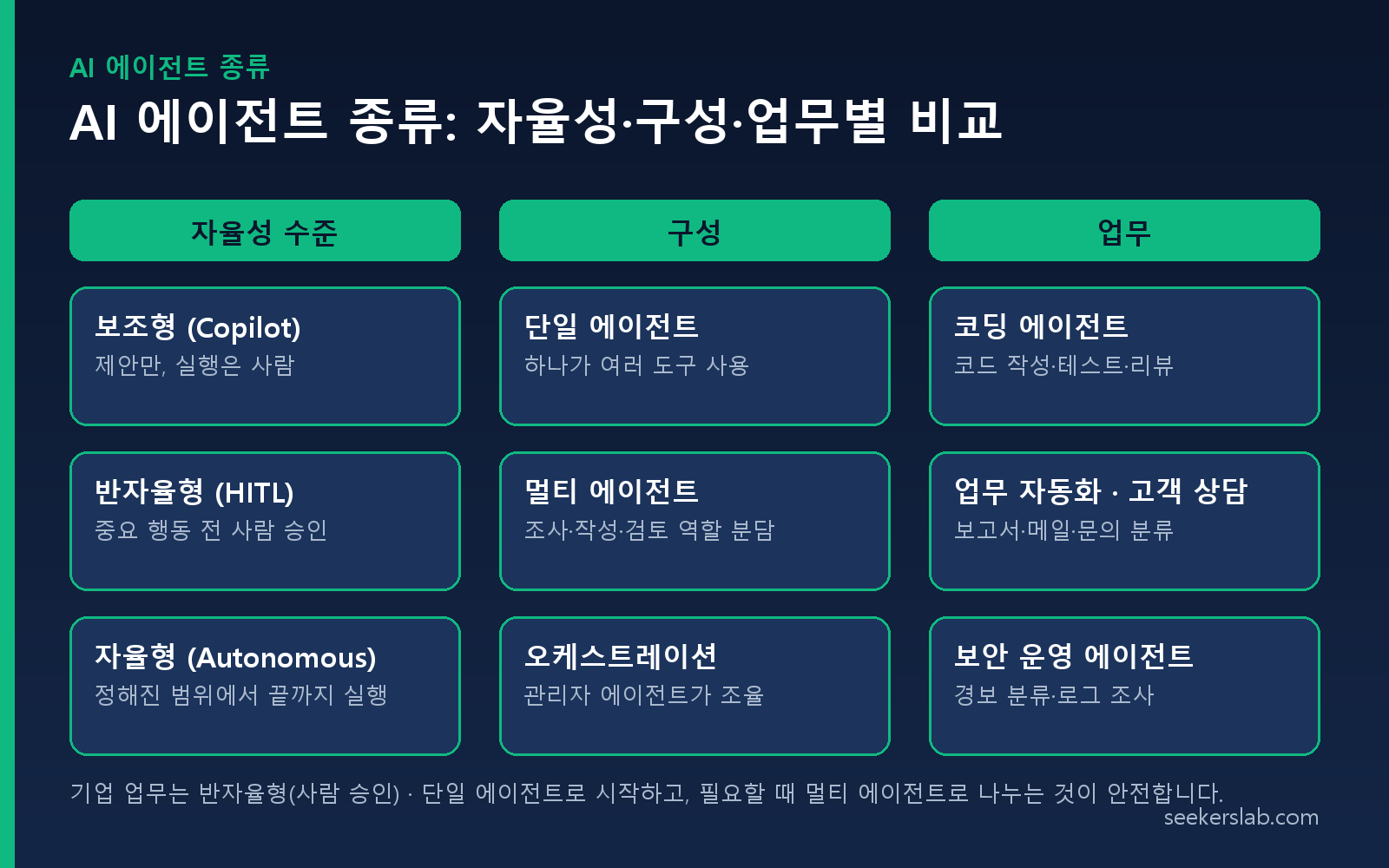 AI Agent Types: A comparison categorized by Autonomy Level, Configuration (Single·Multi-Agent), and Business Function.
1. Types by Autonomy Level
- Assistive (Copilot): This type only provides suggestions while a human works, with execution performed by the human. Examples include code auto-completion and document drafting suggestions.
- Semi-Autonomous (Human-in-the-loop): The agent executes steps, but requires human approval before critical actions such as fund transfers, deletions, or external dispatches. This is often the most practical form for enterprise operations.
- Autonomous: This type executes tasks entirely within a defined scope without requiring approval. It is typically restricted to tasks with minimal impact and easy reversibility.
2. Types by Configuration: Single Agent and Multi-Agent
- Single Agent: A single agent processes tasks using multiple tools. Its simple structure makes it suitable for initial implementation.
- Multi-Agent System: Multiple agents with distinct roles, such as research, drafting, and review, collaborate. The coordinating structure for these agents is termed multi-agent orchestration, typically involving a 'manager' (orchestrator) agent that divides tasks and consolidates results. While advantageous for complex tasks, inter-agent messages can also become attack vectors, increasing the number of control points required.
3. Types by Business Function
- Coding Agent: Code generation, test execution, bug fixing, code review.
- Business Automation Agent (Enterprise AI Agent): Report generation, schedule/email management, data reconciliation between internal systems.
- Customer Service Agent: Inquiry classification, order/reservation lookup, connecting to live agents.
- Security Operations Agent: Alert classification, log investigation, assisting with response procedure execution (refer to AI Agent-based Security Automation).
AI Agent Use Cases: Examples by Business Function
Enterprise AI agents demonstrate significant effectiveness in tasks that are repetitive but involve numerous judgments difficult to process solely through predefined rules.
| Business Function | Agent's Role | Human's Continuing Role |
|---|---|---|
| IT Operations | Summarizes incident tickets, queries related logs, suggests assignee | Determines root cause, approves recovery actions |
| Customer Support | Classifies inquiries, provides initial FAQ-based answers, retrieves order status | Handles refunds/exceptions, manages dissatisfied customers |
| Sales & Marketing | Organizes lead information, drafts proposals, summarizes meeting records | Determines pricing and contract terms |
| Development | Writes and executes tests, fixes simple bugs, provides code review comments | Makes design decisions, approves deployment |
| Security | Classifies initial alerts, retrieves threat intelligence, drafts investigation reports | Decides on response actions like blocking or isolation |
| Finance | Searches internal documents, verifies regulations, organizes consultation records | Transactions/approvals affecting customer assets |
A commonality is that humans approve irreversible decisions. Additional enterprise examples can be found in Enterprise AI Adoption Cases: AX (AI Transformation) Success Stories and Use Cases by Business Function.
Building AI Agents: Development Methods and Frameworks
There are two primary methods for building AI agents: connecting tools within a no-code agent platform, or writing code using an agent framework. Popular open-source frameworks include LangGraph, CrewAI, and AutoGen. Regardless of the method, the development sequence remains similar.
- 1. Define the Goal: Clearly articulate the task the agent must complete and its success criteria in a single statement.
- 2. Design Tools: Define necessary APIs and data as tools, and specify the permissions (read/write) for each tool.
- 3. Select LLM and Prompt: Choose based on task complexity and data egress considerations (cloud API or internal LLM).
- 4. Design Approval Stages: Incorporate human approval before actions that are difficult to revert.
- 5. Test: Verify the agent using a combination of legitimate and adversarial requests (e.g., prompt injection).
- 6. Operate: Log all tool invocations and monitor for anomalous behavior.
The process of designing tools, permissions, verification, and logging to ensure an agent operates securely is also referred to as AI Agent Engineering or Harness Engineering.
Enterprise AI Agent Adoption Stages
- 1. Task Selection: Identify a single business task that is repetitive and involves numerous judgments that are challenging to regularize. A task with minimal potential damage in case of failure is suitable for initial implementation.
- 2. Permission Design: Grant the agent only the essential tools and data access required for its function (principle of least privilege). Ensure that human accounts are not directly borrowed or used by the agent.
- 3. Apply Guardrails: Implement input and output validation to prevent prompt injection, personal information exposure, and prohibited actions.
- 4. Evaluation: Confirm through a test suite whether legitimate requests are processed correctly and malicious requests are blocked.
- 5. Operations: Maintain logs of tool invocations, approvals for critical actions, and monitoring for anomalous behavior.
Further details on phased planning can be found in Enterprise AI Adoption Methods: AX Implementation Stages and Roadmap Guide, and on-premises deployment in Internal AI Deployment Methods: On-Premises LLM·RAG Deployment Costs and Stages.
AI Agent Security Risks: 4 Key Concerns to Address Before Adoption
Since AI agents perform actions, errors can lead not merely to 'incorrect answers' but to 'erroneous executions.' The OWASP Top 10 for LLM Applications 2025 also identifies Prompt Injection (LLM01) and Excessive Agency (LLM06) as primary risks.
| Risk | How it Occurs | Mitigation |
|---|---|---|
| Prompt Injection | Agent executes hidden instructions embedded in documents, emails, or web pages | Input/output guardrails, separation of external content and instructions |
| Excessive Permissions | Scope of damage expands due to tool/data permissions beyond what is necessary | Least privilege, separation of read/write access, approval for critical actions |
| External Tool (MCP) Connectivity | Unverified tool servers or hidden instructions within tool descriptions | Connect only authorized tools, log and review tool invocations |
| Data Leakage | Personal or confidential information leaks through responses or external calls | Personal information masking, external transmission blocking policies |
Financial Security Institute's AI Agent Security Threats and Assessment Criteria
The domestic financial sector is also addressing similar risks. In June 2025, the Financial Security Institute (FSI) disclosed key AI agent security threats, including attacks that manipulate agents through hidden instructions in external data and tool description manipulation. It proposed countermeasures such as decision-making logging and tracing, human review and approval, least privilege, and real-time monitoring. In October 2026, the FSI announced plans to establish AI Agent Security Assessment Criteria (Draft) for the Financial Sector, broadening the scope of inspection from the model layer (e.g., jailbreaking, system prompt leakage) to the execution layer (e.g., execution permissions and isolation, tool execution approval controls, autonomous execution limitations and suspension). As these criteria were reported as a draft, organizations should consult the official FSI announcements for the final content.
Detailed mitigation strategies for each risk are outlined in the following articles:
- AI Agent Security Best Practices: Threats, Permission and Authentication Management, and Breach Prevention
- AI Agent Permission Management: Preventing Misuse with the Principle of Least Privilege
- AI Agent Authentication Management Best Practices: Designing API Call Authentication and Authorization (AuthZ)
- LLM Guardrail Deployment Guide: Prompt Injection Defense and Red Team Testing
To centrally inspect an agent's inputs and outputs, one approach is to implement a layer in front of the LLM that blocks prompt injections and masks personal information, similar to KYRA AI Guardrail (AI Guardrail Solution).
Summary at a Glance
- An AI agent is LLM-based software that receives a goal, autonomously plans, and invokes tools to complete tasks.
- Chatbots generate answers, whereas AI agents perform actions. Agentic AI refers to this operational methodology.
- Its components include LLM, planning, tools, and memory; MCP is used for tool connectivity, and A2A for inter-agent communication.
- Types can be categorized by autonomy (assistive·semi-autonomous·autonomous), configuration (single·multi-agent), and business function.
- Key considerations for enterprise adoption include least privilege, human approval for critical actions, and input/output guardrails.
Frequently Asked Questions
What is the one-sentence definition of an AI agent?
It is software where an LLM autonomously plans and invokes tools to complete tasks upon receiving a goal.
What are the differences between an AI agent and a chatbot?
Chatbots generate answers, while AI agents utilize tools to execute actual tasks. Consequently, agents require concomitant permission management and approval procedures.
Are Agentic AI and AI agent synonymous?
They are similar but distinct. Agentic AI refers to the methodology by which AI autonomously plans and executes, whereas an AI agent refers to an individual software program operating in that manner.
What are the initial steps for building an AI agent?
One should first define a specific business task and delineate the necessary tools (APIs) and data scope for that task. Subsequently, selecting a no-code platform or a framework like LangGraph or CrewAI, and commencing with a limited scope while incorporating human approval stages, is advisable for security.
What is the relationship between an AI agent and MCP?
MCP is a standardized method for AI agents to access external tools and data. While it expands the range of tools an agent can utilize, the greater the number of connected tools, the more critical permission and tool verification management becomes.
When is a multi-agent system necessary?
It is advantageous for complex tasks with clearly divided roles, such as research, drafting, and review. As the number of agents increases, so do the control points. Therefore, it is often preferable to begin with a single agent and expand to a multi-agent system when necessity dictates.
What is the foremost security consideration for enterprises adopting AI agents?
The foremost considerations are least privilege, human approval for critical actions, and input/output guardrails. Implementing these three measures can significantly reduce the scope of damage even if prompt injection occurs.
References
- OWASP Top 10 for LLM Applications 2025
- Model Context Protocol (MCP) Official Documentation
- Byline Network: Financial Security Institute Discloses Key AI Agent Security Threats (June 2025)
- SBS Biz: Financial Security Institute Establishes AI Agent Security Assessment Criteria for the Financial Sector (October 2026)